

How to Restore Central Heating Heat: A Specialist Guide to System Recovery
- Darrell Willamson
- Jun 2
- 12 min read
What if that persistent cold spot at the bottom of your radiator isn't a sign of a dying boiler, but a cry for help from a system choked by internal debris? It's a common frustration to watch your energy bills climb while your living room remains stubbornly cold. You might feel that your only option is to face the £3,000 cost of a new boiler installation. However, the reality is often much simpler. You can restore central heating heat by addressing the circulation failure occurring inside your pipes rather than replacing the entire unit.
We understand how worrying it is when your boiler starts making banging or kettling noises during the winter months. As a specialist local power flush company, we've seen how internal "sludge" creates barriers that DIY bleeding simply cannot reach. This guide will show you how a professional Central Heating Power Flush removes these blockages to improve efficiency and lower your monthly costs. We'll walk you through the technical process of radiator sludge removal and explain how this targeted maintenance safeguards your home's comfort and ensures your system operates at peak performance for years to come.
Key Takeaways
Learn to identify the specific symptoms of internal sludge build-up versus actual mechanical boiler failure.
Understand why simple radiator bleeding often fails to resolve cold spots and when a professional Radiator Power Flush is necessary.
Explore the technical process used to restore central heating heat through high-velocity cleaning and individual radiator agitation.
Discover why hard water in London and the South East accelerates system blockages and how a local specialist provides a targeted solution.
See how a thorough Central Heating Power Flush can significantly lower your energy bills and avoid the expense of a new boiler installation.
Table of Contents
Identifying Why Your Central Heating Has Lost Its Heat
When we discuss heat loss in a domestic setting, we aren't always referring to a boiler that refuses to ignite. Often, the system is technically "working," yet the home remains stubbornly cold. This is a failure of efficiency rather than a total mechanical breakdown. If your boiler is firing but your radiators stay lukewarm, you're paying for energy that never actually reaches your living space. In the current economic climate, where the annual inflation rate for housing and household services hit 3.0% as of April 2026 according to the Office for National Statistics, this type of waste is a significant financial burden. Domestic heating oil prices also saw an 8.5% increase in the same period, making system efficiency a high priority for every homeowner.
A standard Central heating system relies on the unobstructed movement of water to transfer thermal energy from the boiler to your rooms. When circulation blockages occur, the boiler is forced to work harder and cycle more frequently. It consumes more fuel without providing a corresponding increase in room temperature. A professional Central Heating Power Flush serves as both a diagnostic tool and a remedy. It identifies exactly where the system is struggling and clears the path to restore central heating heat throughout the entire property. As a specialist Local Power Flush Company, we often find that what appears to be a terminal boiler fault is actually just a system in desperate need of a deep internal clean.
The Symptoms of a Sludge-Choked System
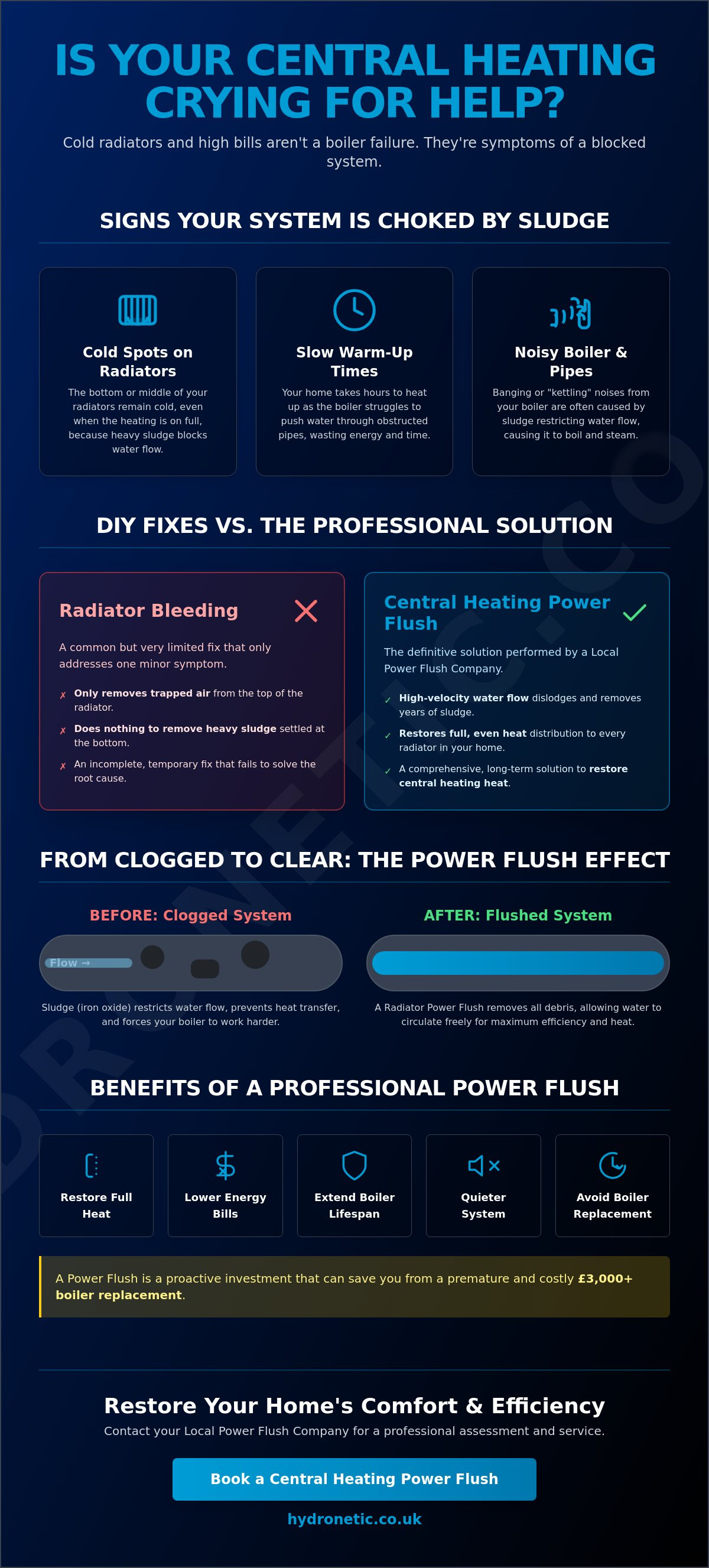
Identifying a circulation issue is a methodical process. You don't need to be a technician to spot the warning signs. You should look for specific physical symptoms that indicate your pipework is obstructed by iron oxide, commonly known as "sludge." These include:
Cold spots located specifically at the bottom or the middle of your radiators while the tops feel warm.
Slow warm-up times where the system takes several hours to reach a comfortable temperature.
Noisy pipework or "kettling" sounds, which resemble a whistling kettle, coming directly from the boiler unit.
Why Bleeding Radiators Isn’t Always the Answer
Many homeowners reach for a radiator key at the first sign of a cold room. While bleeding radiators is effective for removing trapped air, it does nothing to shift heavy, settled sludge. Air naturally rises to the top of a radiator, but sludge is heavy and sinks to the bottom. If you find that bleeding your radiators doesn't restore central heating heat, or if the water that escapes is relatively clear while the radiator remains cold at the base, air isn't your problem. You're dealing with a circulation blockage that requires a high-velocity flush. For a more detailed breakdown of these symptoms, you can read our guide on How to Fix Cold Radiators. Understanding the difference between a simple air pocket and a systemic blockage is the first step toward reclaiming your home's comfort.
Bleeding vs. Power Flushing: Why Simple Fixes Often Fail
While bleeding is a standard task for any homeowner, it only addresses air pockets trapped at the top of the unit. It isn't enough. When you want to restore central heating heat to a system that's been neglected for years, you have to look deeper than the air vent. A professional Radiator Power Flush represents the evolution of system maintenance. It moves beyond superficial fixes to address the heavy, metallic debris that settles deep within your pipework. This process is far more intensive than a basic chemical flush, which relies on the boiler's own weak pump to circulate cleaning agents.
Magnetite, often called black sludge, is more than just dirt. It's a highly effective insulator. Instead of allowing heat to radiate into your room, these deposits trap the thermal energy inside the metal. This forces your boiler to run longer and hotter to achieve the same room temperature. Over time, this buildup migrates to the boiler's heat exchanger and pump. It causes premature wear and, eventually, a total system failure. By properly maintaining and upgrading your equipment through deep cleaning, you can extend the lifespan of these expensive components and restore central heating heat without a full replacement.
The Mechanics of Magnetite Sludge
Magnetite is a byproduct of internal corrosion. It forms when water reacts with the steel and iron components inside your radiators. In a sealed system, this process is slower but still inevitable without proper chemical inhibition. Because magnetite is denser than water, it naturally settles in the lowest parts of the radiators and the narrowest bends of your pipework. This creates a thick, mud-like barrier that restricts flow and kills efficiency. Once this barrier forms, no amount of radiator bleeding will move it.
When DIY Maintenance Reaches Its Limit
There's a significant difference between routine maintenance and system recovery. DIY attempts often involve pouring retail-grade chemicals into the system or attempting a garden hose flush. These methods lack the velocity required for effective Radiator Sludge Removal. In fact, introducing fresh, oxygenated water without professional-grade inhibitors can actually accelerate the corrosion process. If your radiators have significant cold spots or your boiler is frequently "kettling," you've reached the tipping point. At this stage, only high-velocity, low-pressure equipment from a Local Power Flush Company can dislodge stubborn debris. You can explore how our specialist technicians handle these complex blockages on our main service page.
The Technical Process: How a Power Flush Restores System Performance
Restoring a heating system to its original efficiency requires more than just water pressure. A professional Central Heating Power Flush is a high-velocity, low-pressure procedure designed to dislodge and remove the metallic sludge we discussed earlier. Unlike a standard flush, this process uses a specialized pumping station to circulate water at speeds high enough to mobilize heavy debris without damaging delicate pipework or seals. This methodical approach is the most effective way to restore central heating heat when internal circulation has stalled or become uneven.
The process begins by connecting the power flushing unit to the system, typically at the circulation pump or a single radiator. Once the circuit is established, our technicians isolate each radiator one by one. This ensures the full force of the high-velocity flow is concentrated on a single point of resistance. By reversing the flow frequently, we create a turbulent environment that breaks up settled deposits. We also tackle boiler blockages that often cause the system to shut down prematurely. To verify the results, we use thermal imaging cameras to provide visual proof that the cold spots have vanished and heat is radiating evenly across every surface.
Clearing the Boiler Heat Exchanger
The heat exchanger is the most critical component of your boiler. It's where the energy from the gas flame is transferred to your water. When sludge enters this narrow component, it causes "kettling" and reduces hot water production. De-sludging this area is essential for system health. The approach varies depending on your setup. For combi boilers, we focus on the secondary plate heat exchanger to improve hot water delivery. In contrast, open vent systems often require careful cleaning of the feed and expansion pipework to prevent future air-locks and blockages.
Restoring Radiator Efficiency
To ensure a total Radiator Power Flush, we use external pneumatic or electric vibrators. These tools agitate the radiator surface, creating vibrations that break up compacted "black mud" at the base. This ensures we achieve 100% surface area heat rather than just clearing a small path through the center of the sludge. Once the water runs clear, we introduce high-quality chemical inhibitors. These agents coat the internal surfaces of the pipework, providing a protective layer that prevents future rust and ensures your system remains efficient. This proactive step helps restore central heating heat and protects your investment from further corrosion.
When to Call a Local Power Flush Company in London and the Home Counties
London and the South East present a unique challenge for domestic heating. The high mineral content in our local water supply accelerates the formation of limescale within your pipework. When this limescale bonds with the magnetite sludge we discussed earlier, it creates a stubborn, ceramic-like barrier that standard cleaning agents cannot dissolve. To restore central heating heat in these conditions, you need a specialist who understands regional water chemistry. A national call center might send a generalist, but a Local Power Flush Company brings specific expertise regarding the system types common in our area.
Beware of "boiler cowboys" who claim they can fix your system with a simple chemical pour. These quick fixes often involve pouring a bottle of inhibitor into the system without removing the existing debris. This doesn't solve the problem; it just masks the symptoms while the sludge continues to damage your pump and heat exchanger. A proper Central Heating Power Flush is a labor-intensive process that requires professional-grade equipment to be truly effective. It's about total system recovery, not just a temporary patch.
Regional Considerations: Essex, Kent, and Surrey
Properties in Kent and Surrey often feature older, open-vented systems that are particularly susceptible to oxygen ingress and internal rusting. These regional factors lead to specific boiler circulation issues that can cause your pump to burn out prematurely. In Essex, we frequently encounter larger modern developments where high-pressure systems were installed without adequate initial flushing. Our team provides rapid response times across these counties, ensuring that your system recovery is handled by technicians who know exactly what to look for in your specific property type.
Calculating the Cost of Inaction
Ignoring a noisy or inefficient system is a gamble with your finances. With the annual inflation rate for household services at 3.0% as of April 2026, the cost of emergency repairs is only going to rise. A professional Power Flush is a fraction of the cost of a £3,000 boiler installation. Industry data suggests that a clean, sludge-free system can reduce fuel consumption by up to 15%, which is vital considering the 8.5% increase in domestic heating oil prices recorded in early 2026. By choosing to restore central heating heat now, you protect your boiler's lifespan and keep your monthly energy bills under control. If you're ready to safeguard your home's comfort, you can book your Power Flush in London and the Home Counties today.
Restoring Your Home’s Comfort with Hydronetic Power Flush
Choosing a specialist provider is the most effective way to ensure your system recovery is handled with technical precision. At Hydronetic, we maintain a strict focus on system restoration. We don't install new boilers; our entire business is built around making your current heating system perform at its absolute peak. This specialization allows us to invest in superior equipment and refined techniques that general plumbing firms often overlook. Our goal is to restore central heating heat to every corner of your home, ensuring that every radiator is hot from top to bottom without the unnecessary expense of a full system replacement.
You can expect a methodical, disciplined process when we enter your home. We understand that homeowners worry about the mess associated with water-based maintenance. Our technicians use a self-contained circuit that keeps all sludge and debris within our specialized hoses and filtration units. We protect your floors and work surfaces, leaving your property exactly as we found it, only significantly warmer. Once the flush is complete, we provide advice on long-term protection, such as the installation of high-quality magnetic filters to catch future metallic particles before they can settle.
Our Professional Approach
We utilize industry-leading Kamco pumps, which are widely regarded as the benchmark for high-velocity system cleaning. These units allow us to circulate specialized chemicals at the precise flow rates needed to mobilize stubborn magnetite. Throughout the day, our technicians remain transparent about the work being performed. We'll explain the "how" and "why" behind each stage of the process, from the initial thermal check to the final water quality test. You can learn more about our specialist credentials and our commitment to technical excellence on our About Us page.
Next Steps to a Warmer Home
Reclaiming your domestic comfort starts with an accurate assessment of your system's needs. If you're looking for a specialist Power Flush in London or the surrounding Home Counties, we've made the quoting process straightforward and honest. To prepare for our visit, we simply ask that you ensure clear access to your radiators and the boiler area. We'll handle the technical complexities from there. Don't let a sluggish system drive up your energy bills or leave you in the cold during the winter months. Take the first step toward a more efficient, reliable home and restore your central heating heat today with Hydronetic.
Secure Long-Term Efficiency for Your Home
Understanding that heat loss is often a circulation problem rather than a boiler failure is the first step toward saving thousands on unnecessary installations. By addressing the root cause through a professional Central Heating Power Flush, you can clear the magnetite mud that throttles your system's performance and inflates your energy bills. This methodical approach ensures your current equipment operates as it was designed to, providing even warmth across every radiator surface.
At Hydronetic, we provide this specialist expertise across London, Essex, Kent, and Surrey. Our technicians use thermal imaging to verify that we successfully restore central heating heat to every room, giving you visual proof of a healthy system. Because we focus exclusively on restoration rather than replacement, you can trust our advice to be focused on the longevity and efficiency of your existing boiler. It's time to stop tolerating cold spots and start enjoying a truly comfortable home.
Restore your central heating heat today with a professional Power Flush. We look forward to helping you safeguard your domestic comfort and improve your system's reliability for years to come.
Frequently Asked Questions
How do I know if my central heating needs a Power Flush or just bleeding?
You can tell the difference by feeling the temperature across the radiator surface. If the top is cold but the bottom is hot, you have trapped air that needs bleeding. However, if the bottom or middle stays cold while the top is warm, you're dealing with heavy sludge. This debris requires a professional Central Heating Power Flush to remove, as simple bleeding won't shift settled metallic deposits.
Can a Power Flush fix a radiator that is cold at the bottom?
Yes, a Radiator Power Flush is specifically designed to clear cold spots at the base of your heating units. These cold areas are caused by magnetite that has settled due to gravity. By using high-velocity pumps and external agitators, we break up this compacted debris and flush it out of the system. This allows hot water to circulate across the entire surface area once again.
Will a Power Flush damage my old radiators or pipework?
A professional flush is a low-pressure procedure that is generally safe for older systems. While we use high velocity to move debris, the pressure remains low to avoid stressing aged joints or thin radiator walls. In fact, leaving sludge in place is often more dangerous. It causes internal corrosion that eventually leads to pinhole leaks. We always perform a pre-work inspection to ensure your pipework is suitable for the process.
How long does it take to restore central heating heat using a Power Flush?
It usually takes between 6 and 10 hours to fully restore central heating heat in a standard domestic property. The exact duration depends on the number of radiators and the severity of the internal blockages. Our technicians stay on-site until the water runs clear and thermal imaging confirms that every radiator is heating evenly. It's a thorough, one-day process that provides immediate results.
Do I need to replace my boiler if my radiators are not getting hot?
You don't necessarily need a new boiler just because your radiators are cold. Many homeowners are advised to spend thousands on a new installation when the real issue is a circulation blockage. If your boiler fires up but the heat isn't reaching your rooms, the problem is likely in the pipework. A specialist flush from a provider like NBS Plumbing & Heating can often restore central heating heat by returning an old boiler to peak efficiency, saving you the cost of a premature replacement.
What happens if I ignore the sludge build-up in my heating system?
Ignoring sludge build-up leads to a steady decline in efficiency and eventual component failure. As the debris thickens, your pump has to work harder, which often leads to it burning out. Sludge also acts as an insulator in your heat exchanger, causing the boiler to overheat or "kettle." Over time, this neglect can turn a simple maintenance task into an expensive emergency repair or a total system breakdown.
Is a Power Flush effective for both combi and conventional boiler systems?
Yes, the process is highly effective for both combi boilers and conventional open-vent systems. While the technical connection points differ, the goal of removing magnetite remains the same. For combi systems, we pay extra attention to the plate heat exchanger to improve hot water delivery. For conventional systems, we ensure the feed and expansion tanks are cleaned to prevent fresh debris from entering the newly flushed pipework.
How often should I have a professional Power Flush performed?
Most systems benefit from a professional flush every 5 to 10 years. This interval can vary based on the age of your system and whether you have a high-quality magnetic filter installed. If you notice rising energy bills, noisy pipework, or radiators taking longer to warm up, it's a sign that you should call a Local Power Flush Company to assess your system health before a total blockage occurs.


Comments