

Why Power Flushing Restores Hot Water Flow
- Darrell Willamson
- Jun 10
- 12 min read
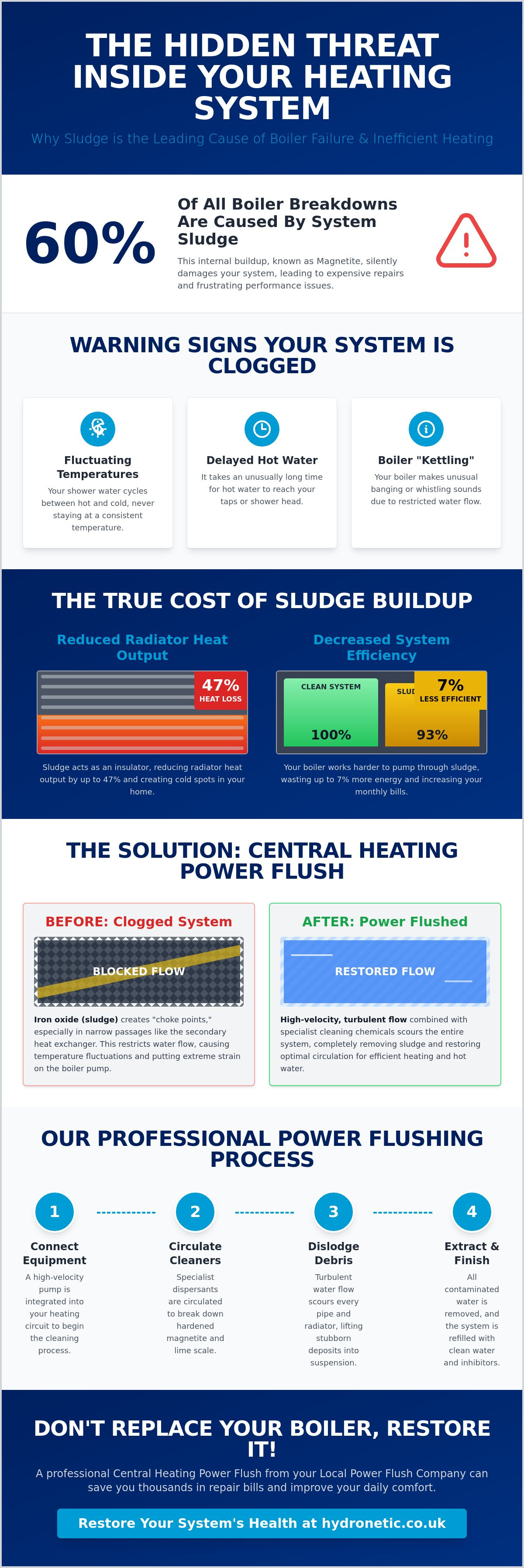
Did you know that sludge is responsible for 60% of all boiler breakdowns in the UK every year? It is a staggering figure, yet many homeowners struggle with lukewarm showers and fluctuating temperatures without realizing the cause is sitting right inside their pipes. If you've noticed your water isn't reaching its usual heat, a professional power flush for hot water flow might be the exact solution you need. As a Local Power Flush Company, we've seen how internal blockages can reduce radiator heat output by as much as 47%, forcing your system to work harder for poorer results.
We understand the frustration of rising energy bills coupled with a system that simply won't perform. You shouldn't have to consider a full boiler replacement when the issue is often a matter of circulation rather than mechanical failure. In this article, we'll explain how a Central Heating Power Flush clears out years of accumulated debris to restore efficiency. You will discover the technical process behind a Radiator Power Flush and how this methodical cleaning extends the life of your heating system while ensuring your morning shower stays hot and consistent.
Key Takeaways
Identify how internal corrosion and magnetite create "choke points" that cause fluctuating shower temperatures and lukewarm water.
Understand the mechanical role of the secondary heat exchanger and how a targeted power flush for hot water flow restores its efficiency.
Learn why many boilers diagnosed as "broken" are actually suffering from circulation issues that a Central Heating Power Flush can resolve.
Discover the technical stages of a Radiator Power Flush, from connecting high-velocity pumps to using specialist cleaning chemicals.
Find out why partnering with a Local Power Flush Company provides a more thorough, specialist result than relying on a general plumber.
Table of Contents
Why Your Hot Water Flow is Failing: The Role of System Sludge
When your hot water begins to fail, the natural instinct is to blame the boiler's mechanical components. However, the root cause is frequently found within the water itself. Over time, the metal surfaces inside your central heating system react with oxygen to create iron oxide, commonly known as black sludge or magnetite. This heavy, metallic debris doesn't just sit at the bottom of your radiators; it circulates through the entire circuit, settling in the narrowest passages of your pipework.
These internal "choke points" are particularly damaging to hot water production. Most modern boilers, especially combi boilers, rely on a component called a secondary heat exchanger. This part has very thin channels that allow heat to transfer from the heating water to your tap water. When sludge enters these channels, it restricts the flow. Your boiler then struggles to modulate its temperature correctly. It senses the water is getting too hot because it isn't moving fast enough, so it shuts the burner off. This results in the frustrating "hot-cold-hot" cycle in your shower. Investing in a professional power flush for hot water flow is often the only way to clear these surgical blockages without replacing expensive parts.
Ignoring these early signs of restricted flow can lead to permanent damage. Sludge is responsible for 60% of all boiler breakdowns in the UK. When the system is forced to pump through thick, contaminated water, the internal pump and diverter valves experience excessive wear. What starts as a minor temperature fluctuation can quickly escalate into a total system failure, leaving you with a high repair bill that a preventative Central Heating Power Flush could have avoided.
Common Symptoms of a Sludge-Blocked System
Delayed delivery: Hot water that takes an unusually long time to reach your taps or shower head.
Temperature fluctuations: Water that oscillates between hot and cold unexpectedly while the tap is running.
Boiler "Kettling": Unusual banging or whistling sounds coming from the boiler, caused by localized overheating due to restricted water movement.
How Magnetite Affects Your Daily Comfort
The chemical process of corrosion is a silent efficiency killer. While your radiators might feel warm, the hot water often remains lukewarm because the heat exchanger is too fouled to transfer energy effectively. This creates a deceptive situation where the system appears to be working, yet your comfort is compromised. As a Local Power Flush Company, we often find that systems with significant sludge buildup are up to 7% less efficient. This means you're paying more on your monthly energy bills for a lower quality of heat. A targeted Radiator Power Flush removes this insulating layer of magnetite, restoring the thermal conductivity of your entire home.
How a Central Heating Power Flush Restores Hot Water Production
A Power Flush is a specialized maintenance procedure involving a high-velocity, low-pressure pumping unit that circulates water and chemicals through your entire heating circuit. Unlike a standard system drain, which relies on gravity and often leaves heavy debris behind, a professional power flush for hot water flow uses turbulent flow to dislodge stubborn magnetite. By properly maintaining and upgrading your equipment through this process, you ensure that every radiator and internal boiler component is stripped of restrictive buildup.
The secondary heat exchanger is the heart of hot water production in combi boilers. This component is essentially a series of tightly packed metal plates. When sludge enters these narrow gaps, the heat transfer from the primary circuit to your domestic water supply is severely throttled. A targeted power flush for hot water flow forces cleaning agents through these plates at high speed, dissolving the lime and rust that a manual flush simply cannot reach.
Professional-grade chemicals play a vital role here. We use specific dispersants that break down the molecular bonds of hardened magnetite, turning it into a suspended liquid that we can then safely extract from the system. This chemical action, combined with high-velocity circulation, ensures that we aren't just moving sludge around, but actually removing it. If you're experiencing temperature drops, consulting a Local Power Flush Company can help determine if your heat exchanger is salvageable through this deep-cleaning method.
Targeting the Boiler's Internal Blockages
Sludge doesn't just sit in radiators; it settles in the narrowest channels of the boiler's internal pipework. During the process, we often isolate the boiler to flush it independently. This ensures maximum pressure is directed at the "choke points" within the unit. By restoring the "path of least resistance," we allow water to travel freely through the primary circuit. This is essential for consistent hot water production and long-term system health.
Improving Heat Transfer and Flow Rates
A clean heat exchanger drastically improves thermal efficiency by removing the insulating layer of sludge that prevents heat from reaching your water. In a sludge-choked pipe, the water must fight against friction and physical barriers, which causes your boiler pump to work overtime. Once the system is flushed and clear, the pump operates under significantly less stress. This restoration of flow not only brings back your hot water but also protects the pump from premature failure.
Power Flush vs. Boiler Repair: Identifying the Root Cause
Facing a failing boiler often leads to a stressful choice between expensive repairs or a total replacement. However, many boilers diagnosed as "broken" are simply suffering from severe circulation issues. Before committing to the cost of a new installation, it is vital to determine if the system is mechanically failing or just heavily congested. A professional power flush for hot water flow is a fraction of the cost of a new boiler and can often restore a system to its original performance levels without the need for invasive structural work.
Replacing individual components like a circulating pump or a diverter valve is often a temporary fix if the underlying water quality isn't addressed. Sludge is an abrasive substance. When you install a new, expensive part into a system saturated with magnetite, that part is immediately exposed to the same contaminants that killed the previous one. This cycle leads to recurring repair bills and mounting frustration. A diagnostic health check should always be the first step. It allows a specialist to see if the boiler is genuinely at the end of its life or if it just needs the internal blockages cleared to function correctly again.
Is it a Blockage or a Mechanical Failure?
Differentiating between a mechanical fault and a blockage requires a methodical approach. If your boiler is "kettling"—making a sound like a boiling kettle—it is usually a sign of localized overheating caused by sludge deposits on the heat exchanger. This is a circulation issue, not necessarily a faulty thermostat. Similarly, a diverter valve that fails to switch between heating and hot water is often just jammed with metallic grit. A Radiator Power Flush removes these physical obstructions, allowing mechanical parts to move freely. If the boiler fires up but shuts down quickly, it's likely a flow problem that a Central Heating Power Flush can rectify.
Protecting Your Manufacturer's Guarantee
Modern boiler manufacturers are increasingly strict about water quality. In many cases, a warranty is only valid if the system was thoroughly cleaned and treated with inhibitors at the time of installation. If you fit a new part or a new boiler without performing a Power Flush, you risk voiding your protection. Professional documentation of a flush serves as proof that you've maintained the system to industry standards. As a Local Power Flush Company, we provide the necessary certification to safeguard your long-term investment. You can learn more about our commitment to technical excellence on Hydronetic's about page, where we detail our specialist approach to system restoration.
The Professional Power Flushing Process: What to Expect
The process begins with the connection of a specialized high-velocity power flushing pump. We typically attach this unit at the circulating pump head or across a radiator's valves to ensure the cleaning solution reaches every corner of the circuit. Once the connection is secure, we introduce professional-grade chemicals designed to loosen deep-seated magnetite and rust. These dispersants break down the hardened sludge that has accumulated over years of operation. Unlike a standard flush, a professional power flush for hot water flow involves isolating each radiator and pipe run individually. By focusing the full force of the pump on one section at a time, we ensure a 100% clear circuit, purging debris that has been baked onto internal surfaces.
During the procedure, we use the pump's flow-reversal feature to create turbulence within the pipes. This rapid change in direction helps dislodge stubborn blockages that a single-direction flow might miss. We continue this process until the water running through our diagnostic sight glass is completely clear. Once the system is clean, we conduct a final water quality test to check pH levels and total dissolved solids. We then add a high-performance chemical inhibitor. This creates a protective film over the internal metal surfaces, preventing the chemical reaction that causes future corrosion. If you've noticed your system's performance dipping, you can book a professional system assessment with our local team to prevent further deterioration.
Tailoring the Flush to Your System Type
Every home requires a slightly different technical approach based on its boiler configuration. A Combi Boiler Power Flush involves specific steps to protect the delicate secondary heat exchanger while ensuring the internal bypass is thoroughly cleaned. For Sealed Systems, we monitor pressure gauges constantly to ensure safety valves don't trigger during the high-velocity phase. Conversely, Open Vented Systems require us to cap off the cold feed and expansion pipes to prevent cleaning chemicals from entering the loft tanks. We use protective floor covers and waterproof seals at every connection point to ensure no mess is left behind in your home.
Final Testing and Commissioning
We don't consider the service complete until we've verified the restoration of your system's efficiency. Our technicians use digital thermometers to confirm that every radiator is heating evenly from top to bottom, with no cold spots. We also measure the temperature rise at your hot water taps to ensure the boiler is modulating correctly and delivering consistent heat. Finally, we provide a certificate of completion. This document serves as a record of maintenance and is frequently required by manufacturers to keep your boiler's warranty valid. This methodical approach ensures your power flush for hot water flow provides lasting value and domestic comfort.
Hydronetic: Specialist Power Flushing Across London and the Home Counties
Choosing a Local Power Flush Company over a general plumber ensures your system receives the attention of a technician who specializes in restoration rather than just general maintenance. While many plumbers offer flushing as a secondary service, our core discipline is the Central Heating Power Flush. This specialization allows us to invest in high-velocity equipment and specific chemical formulations that generalists often overlook. By focusing on the root cause of circulation failure, we provide a methodical solution that avoids the massive expense of a full boiler replacement.
We provide expert coverage across London, Essex, Kent, and Surrey, allowing for a rapid response to homeowners dealing with lukewarm water or noisy systems. Our diagnostic approach is designed to save you money by identifying exactly where blockages exist. Instead of suggesting a new boiler, we focus on clearing internal blockages and boiler debris to restore your home's comfort. Our technicians have extensive experience with the diverse range of system types found across the Home Counties, from Victorian open-vented setups to modern high-pressure sealed circuits. This regional expertise ensures we understand the specific water quality challenges and pipework configurations unique to your area.
Local Expertise You Can Trust
Our focus remains strictly on the technical process of Central Heating Power Flush procedures and Radiator Power Flush services. This narrow focus ensures we've seen every possible sludge-related issue and know the most efficient way to rectify it. Our regional knowledge is particularly valuable when dealing with the specific water hardness levels and system configurations common in London and Essex. We prioritize clearing complex boiler blockages to restore hot water flow, ensuring your primary heat source operates at peak efficiency once again without the need for invasive structural changes.
Next Steps: Restoring Your Home's Comfort
Booking a specialist assessment is a straightforward process designed to give you clarity on your system's health. When you get in touch, it's helpful to have a few details ready, such as the approximate age of your boiler and the total number of radiators in your property. This information allows us to tailor our equipment and chemical quantities to your specific needs, ensuring the best possible outcome for your system. Contact Hydronetic Power Flush today to restore your hot water flow and protect your home from the long-term consequences of system neglect.
Secure the Long-Term Health of Your Heating System
A struggle for consistent hot water is often a symptom of poor system hygiene rather than a terminal mechanical failure. By addressing the accumulation of magnetite through a professional Central Heating Power Flush, you can resolve fluctuating temperatures and noisy operation without the extreme expense of a new boiler. This methodical restoration clears the internal "choke points" that hinder your heat exchanger, ensuring your home remains warm and efficient for years to come.
Our team provides expert maintenance and specialized Boiler Blockage Clearance across London, Essex, Kent, and Surrey. We pride ourselves on a diagnostic approach that prioritizes system restoration and long-term value. Don't let sludge compromise your domestic comfort or lead to unnecessary repair bills. A targeted power flush for hot water flow is the most effective way to safeguard your investment and return your system to peak performance levels.
Ready to restore your system? Book your Specialist Power Flush assessment with Hydronetic today. We look forward to helping you achieve a more reliable and efficient home heating environment.
Frequently Asked Questions
Will a power flush increase my hot water pressure?
A power flush doesn't increase the incoming mains water pressure, but it significantly improves the flow rate. When internal channels are blocked with sludge, the volume of water reaching your taps is restricted. By removing these obstructions, a professional power flush for hot water flow restores the system's ability to deliver a consistent, full volume of heated water to your showers and taps.
How do I know if my hot water issue is a blockage or a broken boiler?
Blockages often present as "kettling" noises or radiators that stay cold at the bottom while the boiler is running. If your boiler fires up but shuts down almost immediately, it's likely a circulation problem rather than a mechanical failure. A specialist from a Local Power Flush Company can perform a diagnostic check to see if sludge is preventing heat transfer before you commit to expensive repairs.
Can a power flush fix a boiler that keeps cutting out?
Yes, if the cutting out is caused by overheating due to restricted circulation. When magnetite builds up, the water cannot move fast enough to carry heat away from the heat exchanger. The boiler's safety sensors detect this spike in temperature and shut the system down to prevent damage. A Central Heating Power Flush removes this debris, allowing the boiler to run continuously without overheating.
How long does it take to restore hot water flow with a power flush?
A thorough, professional service typically takes between 6 and 8 hours to complete. The exact duration depends on the size of your property and the severity of the magnetite accumulation. Because we isolate and clean each radiator individually, we ensure the entire circuit is clear. This methodical approach is the most reliable way to achieve a lasting power flush for hot water flow restoration.
Is a power flush safe for older central heating systems?
Specialists use high-velocity, low-pressure pumps specifically designed to be safe for older pipework. While the water moves quickly to dislodge sludge, the pressure remains low to avoid stressing aged joints or thin radiator walls. It is a controlled process that focuses on cleaning rather than force. This makes a Radiator Power Flush a safe and effective way to rejuvenate an aging heating circuit.
Will a power flush remove limescale as well as sludge?
The process uses specialized chemical flushing agents that are formulated to dissolve both magnetite and calcium deposits. Limescale is a common issue in hard water areas like London and Essex, often coating the internal plates of the heat exchanger. By combining high-velocity circulation with these professional chemicals, we can strip away both types of buildup to restore thermal efficiency.
How often should I have my central heating system power flushed?
Industry experts generally recommend a professional flush every 5 to 6 years to maintain peak efficiency. Regular maintenance prevents the heavy accumulation of sludge that causes 60% of all UK boiler breakdowns. If you've recently moved into a property or haven't had the system cleaned in over half a decade, a preventative flush is a wise investment in your home's comfort.
What happens if I don't flush my system when hot water flow starts to fail?
Ignoring the early signs of restricted flow almost always leads to total component failure. Sludge is abrasive and will eventually destroy your boiler's internal pump and diverter valves. What could have been a straightforward cleaning job often turns into a requirement for a full boiler replacement. Taking action early safeguards your system and prevents the high costs associated with emergency heating repairs.


Comments